
Nagelsmann’s Triple Change Worked. So Why Was It Needed at All?
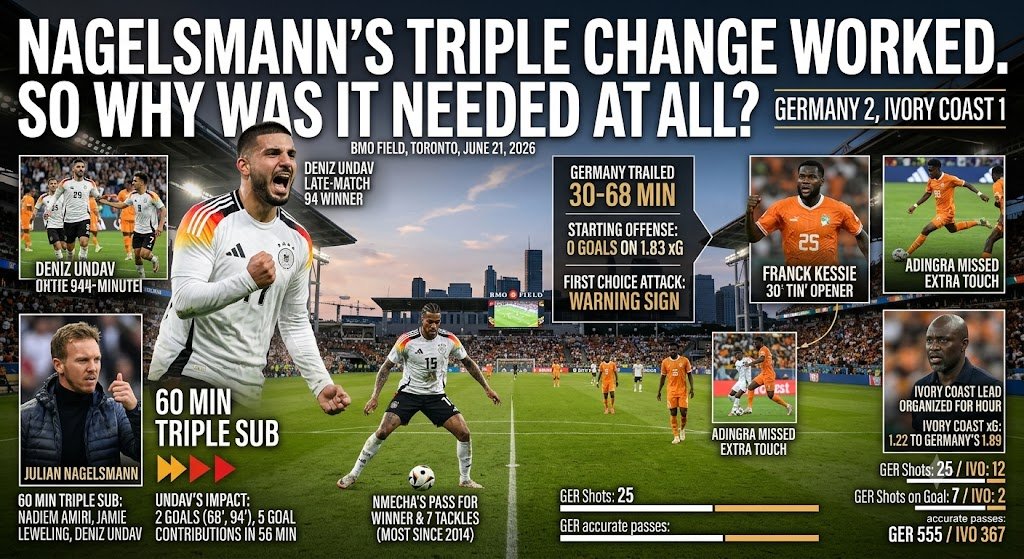
Julian Nagelsmann won this match in the 60th minute, not the 90th. That is the real story of Germany 2, Ivory Coast 1 at BMO Field in Toronto on June 21, 2026, in their Group E meeting at the 2026 World Cup. Germany trailed for half the night, dragged it back through two substitute strikes, and still needed a fourth-minute stoppage-time winner to beat a team they out-rated by every metric except the one that decides points.
Here is the direct answer. Germany beat Ivory Coast 2-1. Franck Kessie put Ivory Coast ahead in the 30th minute. Deniz Undav leveled in the 68th minute, then won it in the 94th. Germany finish the group stage already through to the round of 32, while Ivory Coast must now go and find a result against Ecuador or Curacao to be sure of joining them.
Make no mistake, the headline says rescue act. The performance underneath it says something more uncomfortable for the winning manager.
Start with the decision that actually worked. Nagelsmann did not make one substitution at the hour mark. He made three at once, sending on Nadiem Amiri, Jamie Leweling, and Undav together for Pavlovic, Sane, and Musiala. That is not a tweak. That is a coach admitting his first eleven had stopped functioning and refusing to wait another ten minutes to say so.
The logic behind it was sound before either substitute touched the ball. Germany had created 1.83 expected goals to that point and converted none of it, while Ivory Coast sat compact and let Kessie’s smash-and-grab do the rest. Nagelsmann needed fresh legs against tired ones, and he needed a different kind of attacker. Undav had scored a brace off the bench in the opener against Curacao. Sending him on again was not a hunch. It was simply trusting the evidence already in front of him.
It worked twice. Amiri’s cross found Undav for the equalizer in the 68th minute, a controlled volley from inside the box. Then Felix Nmecha, who had quietly put in seven tackles by full time, the most by a German player at a World Cup since 2014, slid the pass that let Undav turn and finish from sixteen yards in the 94th minute.
Two goals. Zero minutes started. Undav now has five goal contributions from 56 minutes of World Cup football this tournament.
Now the harder question. Why did Germany need rescuing against a side they beat in shots on goal seven to two, in accurate passes 555 to 367, and in expected goals 1.89 to 1.22?
The honest answer for Emerse Fae is that none of those numbers stopped his team going ahead and staying organized enough to make Germany sweat for an hour. Fae’s logic on the opener was not lucky. Yan Diomande burst down the left, Nathaniel Brown made a brilliant block on Amad Diallo’s first effort, and Kessie was alert enough to smash the loose ball in from close range anyway. Ivory Coast also forced two German efforts to be ruled out for fouls in the box, and twice nearly doubled their lead through Kessie and Christ Inao Oulai before Undav ever touched the ball.
The flaw in Fae’s setup, if there was one, is that his team had nothing to throw forward once Germany started rotating fresh legs in. After the 60th minute, Ivory Coast’s only real openings came from set pieces and scraps. Simon Adingra wasted the biggest one in the 90th minute, taking an extra touch inside the box when the first-time finish was on, and Germany cleared the danger before he could try again.
That moment follows Fae into next week more than the scoreline does. One touch, one hesitation, and a point against the group’s best side disappears.
For Nagelsmann, the stat that should worry him is not on the scoreboard. Germany needed 25 shots and 1.89 expected goals to score twice from open play, and their two best chances before the substitutions, from Wirtz and Havertz, both came back off the woodwork or the goalkeeper. A finishing record like that against a stronger side than Ivory Coast in the knockout rounds gets punished, not rescued.
Here is the thing about a result like this. It can be both a triumph of game management and a warning sign about the squad’s first-choice attack, and both of those things are completely true at once.
Fae leaves Toronto with more clarity than Nagelsmann, oddly enough. He knows exactly what his team needs against Ecuador or Curacao: an early goal and the discipline to defend the lead without a Kessie moment of brilliance bailing them out twice. Nagelsmann leaves with a different problem. His most clinical forward spent the night on the bench, and the manager now has to decide whether that is a tactic or an admission.