
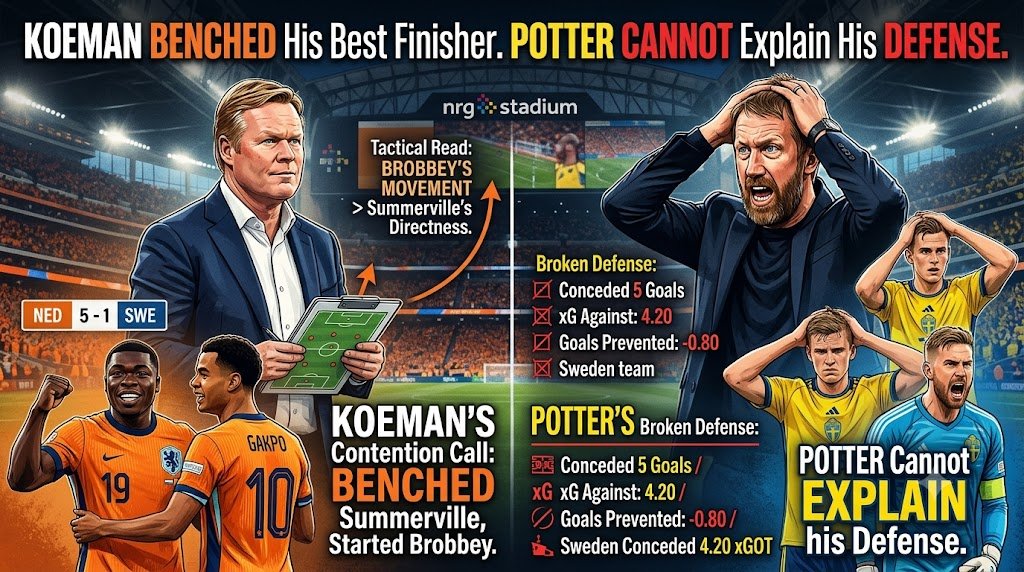
Koeman Benched His Best Finisher. Potter Cannot Explain His Defense.
Ronald Koeman dropped Crysencio Summerville, a scorer against Japan five days earlier, and started Brian Brobbey instead. That decision is the headline nobody is writing tonight, because Netherlands hit five and the scoreline buried everything else. Netherlands beat Sweden 5-1 at NRG Stadium in Houston on June 20, 2026, in their Group F match at the 2026 World Cup, and the gamble at the center of it deserves more credit than a 5-1 win usually gets.
Here is the direct answer first. Brobbey scored in the 5th and 17th minutes. Gakpo added two more in the 47th and 54th. Elanga pulled one back for Sweden in the 59th, and Summerville, introduced as a halftime substitute, finished the rout in the 89th. Netherlands move top of Group F. Sweden’s clean goal difference from a 5-1 win over Tunisia is gone, replaced by a result that leaves Graham Potter facing Japan with no margin left.
Truth is, Koeman’s selection call was the whole game before it even kicked off.
Leaving out a player who had just scored is the kind of decision that gets a manager fired when it fails. Koeman made it anyway, betting that Brobbey’s movement in the box suited this Swedish back line better than Summerville’s directness from the left. Two goals in the first 17 minutes, both close-range finishes off low crosses, proved the read correct. Brobbey was not lucky. He was exactly where Koeman’s plan put him.
The same coach then made the call look even smarter without changing his mind about Summerville at all. He sent the West Ham forward on for Donyell Malen at the break, by which point Sweden were already chasing the game and could not set up to stop a second wave of the same problem. Summerville set up Gakpo’s fourth goal and scored the fifth himself.
One man, two different uses, the same correct conclusion both times.
Potter’s defense for his side starts with the part that nearly worked. Sweden weathered an early storm and finished the first half on top, with Gustaf Lagerbielke even having a header ruled out for offside in stoppage time. The logic behind sitting in and waiting for daylight was not unreasonable against a Dutch side missing nobody and rotating fresh legs every twenty minutes. The problem is what happened the moment Netherlands turned the second half on. Gakpo scored twice in seven minutes, and Sweden never found an answer to either goal.
The number that follows Potter into the Japan match is brutal. Sweden conceded 4.20 expected goals on target against a team that needed only 2.61 expected goals to produce five actual ones. That gap between chances allowed and chances taken is not bad luck repeating itself. It is a back line that kept inviting shots from inside the six-yard box and a goalkeeper, Kristoffer Nordfeldt, who finished with a goals-prevented figure of minus 0.80, meaning he let in more than the shots themselves suggested he should have.
Here is the thing about Koeman’s challenge now. A 5-1 win raises the bar for every game after it, and Netherlands still have to beat Tunisia to guarantee top spot outright. Gakpo has now matched Robin van Persie’s Dutch record for World Cup group-stage goals, and the pressure to keep finding that level only grows from here. Big wins do not earn rest. They earn higher expectations.
Sweden, meanwhile, no longer control their own group. They need a result against Japan, and they need their defense to look nothing like it did in Houston.
Koeman leaves this one in a position no manager argues with. He left a proven scorer out of his XI, the move worked, and his backup plan worked just as well an hour later. Potter leaves with a goal difference wiped clean and a defensive question he still has not answered. The job is not under threat yet. The answer to Wednesday’s question certainly is.