
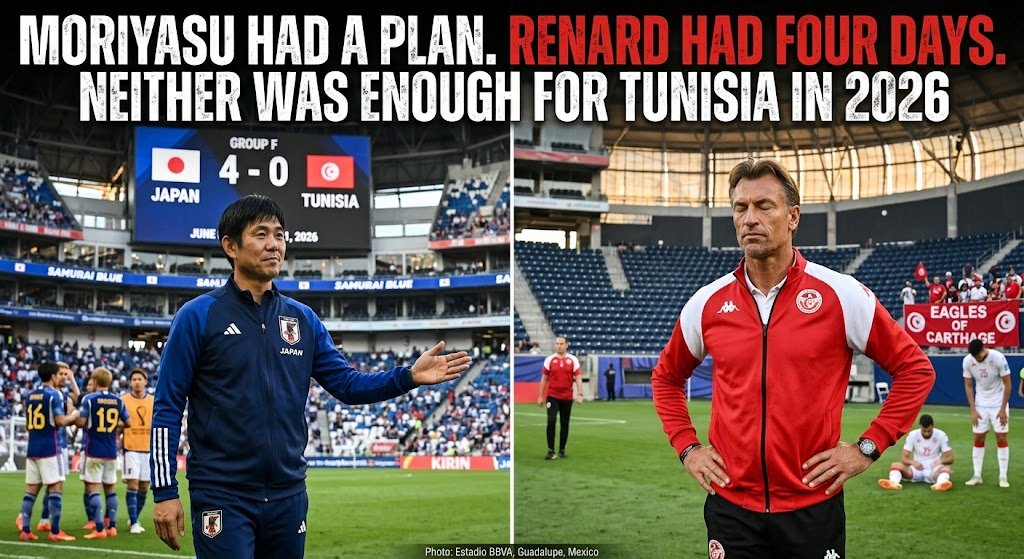
Moriyasu Had a Plan. Renard Had Four Days. Neither Was Enough for Tunisia in 2026
Herve Renard was appointed to save Tunisia’s World Cup. He was given the job after a 5-1 defeat to Sweden the kind of result that ends careers without warning and asked to walk into a second group game against one of Asia’s most structured, most dangerous sides and turn the whole thing around. Four days. One game to keep a tournament alive. At Estadio BBVA in Guadalupe, Mexico, on June 21, 2026, Japan beat Tunisia 4-0 in a Group F match that eliminated the Eagles of Carthage and confirmed everything Hajime Moriyasu’s side had been building toward.
Japan scored through Daichi Kamada in the 4th minute, Ayase Ueda in the 31st and 83rd, and Junya Ito in the 69th. Tunisia finished with an xG of 0.05. Japan’s was 2.13. A team need not win every duel, every header, or every fifty-fifty ball to dominate a match at a World Cup. Sometimes the numbers just say it plainly and there is nothing left to argue about.
Moriyasu’s most important decision came before kick-off and went largely unremarked upon in the noise around Renard’s appointment. He set Japan up in a 3-4-2-1 that mirrored Tunisia’s own shape exactly. That is not accidental. Matching a struggling side’s formation removes tactical uncertainty from the equation both teams see the same spaces, the same overloads and forces the better players to simply be better. Japan’s were. Kou Itakura attempted 80 passes from centre-back, more than any player on the pitch, and provided the assist for Ueda’s second goal with a drive forward during a fast break in the 31st minute. Keito Nakamura made it 1-0 in the fourth minute with a left-wing cross that Kamada barely had to move to turn in from close range, an 0.72 xG chance converted at a distance of four yards. Japan were simply more alive to the moments that decided the match. That is not luck. That is preparation.
Renard’s logic in setting up with the same 3-4-2-1 was defensively sound on paper. A back three with two midfield shields, compact, organized, difficult to break down quickly. Against Sweden it collapsed under pressure. Against Japan it lasted less than four minutes.
Truth is, the structural decision was not where Renard lost this. He lost it in the final third. Tunisia recorded two shots all match, both off target, and an xG so close to zero it barely registers. Sebastian Tounekti, who started up front and was pulled off at the 64th minute, touched the ball 16 times and completed nine passes. Nine. In a World Cup match. That is not a striker being unlucky.
That is a player completely cut off from his team’s attacking intent, by a midfield that could not find him and a system that gave him nothing to work with. Hannibal Mejbri, Tunisia’s most creative player and the one most likely to find a moment of individual quality, saw more of the ball in the second half but his passing was poor, the delivery loose, and by that point Japan were already coasting toward their largest ever winning margin at a World Cup.
Aymen Dahmen deserves a mention here, because he was very often the only Tunisian player doing his job properly. He made five saves, kept the score at 2-0 deep into the second half, and posted a goals-prevented figure of -1.26 meaning he actually outperformed his expected goals conceded by more than a goal. A goalkeeper carrying a team to that degree is not a minor detail. It tells you everything about how lopsided this match really was.
Ueda’s afternoon was something else. Two goals, one assist, five shots, three on target. He scored from outside the box in the 31st minute with a low angled strike the data gave just 0.03 xG meaning it was not expected to go in, and he made it go in anyway. Then he looped a header from Kaishu Sano’s cross into the bottom corner in the 83rd minute. Two different kinds of finish. Both composed. Both decisive.
Moriyasu faces a harder problem now, and he should not be allowed to enjoy this too long without someone asking it. Sweden await in Dallas, a side with a positive goal difference, more physical intensity across the lines, and far less inclination to drop as deep as Tunisia did. Japan have not lost to a European side in ninety minutes since 2019, which is genuinely remarkable, but this was also not a stress test. Japan won every aerial duel that mattered today. Against Sweden, that number will be contested far more seriously, and Moriyasu will need to think carefully about how his back three handles that pressure without Tomiyasu, who was substituted in the 79th minute and whose attacking instinct from right centre-back has been one of Japan’s most reliable outlets across both games.
As for Renard he has one match left. Against the Netherlands. Zero points. Minus eight goal difference. A side that has conceded nine goals in two games and managed an xG of roughly 0.20 across them both.
Moriyasu leaves Guadalupe as the stronger manager. By a margin that is not close and does not require qualification. His team produced the biggest winning margin ever recorded by an Asian nation at a World Cup, and they did it with structure, pace, and a genuine cutting edge at the top of the pitch. Renard inherits a situation that no manager of his quality should have to face, and the honest question is not whether he survives it it is whether Tunisia can find anything in the next ninety minutes that suggests the future holds more than this. The tournament record of 0-0-2, minus eight goals, zero shots on target, says the answer is no.