
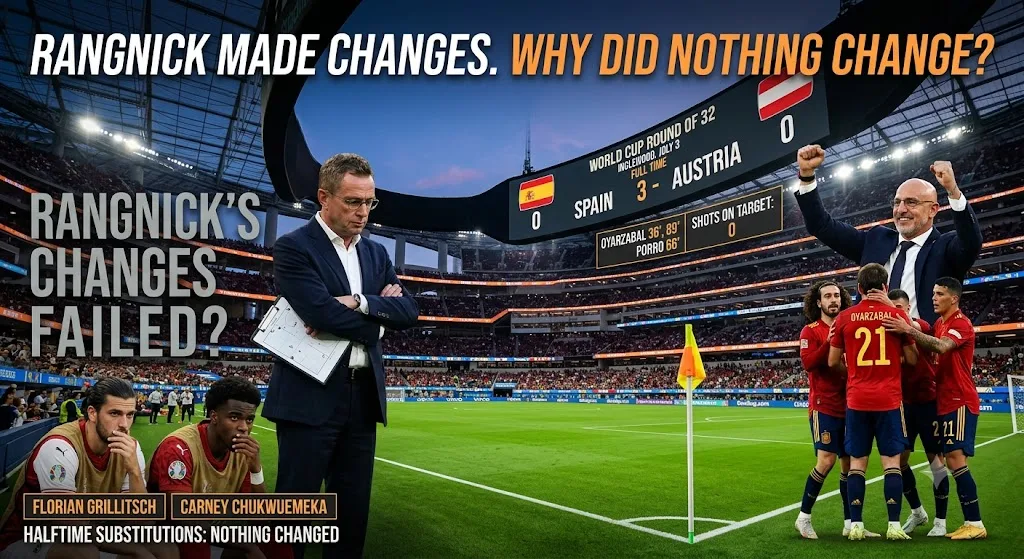
Rangnick Made Changes at Half-time. Why Did Nothing Change
Every manager defends bold changes when they work. Ralf Rangnick has no such luck tonight. Spain beat Austria 3-0 at SoFi Stadium in Inglewood on July 3, in a Round of 32 World Cup match that ended Austria’s tournament and sent Luis de la Fuente’s side through to face Portugal or Croatia.
Spain won it comfortably. Mikel Oyarzabal scored twice, in the 36th and 89th minutes, either side of a Pedro Porro header in the 66th. Austria never had a shot on target across the full ninety.
Here is the question Rangnick cannot avoid this week: why did his double substitution at half-time change nothing at all.
Why De La Fuente’s Setup Actually Worked
Spain’s front four rotated positions constantly, and Austria’s back line never adjusted to track the movement. Marc Cucurella supplied both assists for Oyarzabal’s goals, first with a low cross in the 36th minute and again with a searching pass in the 89th.
That is not chance. That is a manager building a system where the full-back becomes the primary creator, and trusting his winger and forward to read the same pattern twice in one match.
Lamine Yamal drew Austria’s full-backs out of position all night, and Dani Olmo and Alex Baena exploited the gaps left behind.
Why Rangnick’s Gamble Made Sense on Paper
Bringing on Florian Grillitsch and Carney Chukwuemeka at half-time was the correct read of the problem. Austria had faced 11 shots and conceded once already, and Rangnick needed fresh legs to close down Spain’s midfield triangle before it picked them apart again.
The logic was sound. Sasa Kalajdzic almost equalized within a minute of coming on, heading narrowly over from Marcel Sabitzer’s cross in the 61st minute. Had that gone in, Rangnick’s changes look inspired.
Instead, Spain scored five minutes later. Porro’s header made it 2-0, and every subsequent Austria substitution chased a game that was already gone.
The Number That Follows Austria Home
Austria finished with zero shots on target from five attempts, against an xG of 0.32.
That number will sit with Rangnick through the rest of the tournament build. This was not a team that created and wasted chances. This was a team that barely threatened Unai Simon’s goal across the full ninety minutes, managing only 30% of duels won and 15 fouls to Spain’s eight, a foul count that speaks to a side chasing shadows rather than the ball.
What Challenge De La Fuente Now Faces
Spain deserve credit, and Oyarzabal deserves the headlines. Still, there is a pattern worth watching. Spain have needed penalty shootouts to exit their last two World Cup knockout ties, in 2018 and 2022, and this comfortable scoreline against a team that offered almost nothing will tell De La Fuente little about how his side handles real pressure.
Portugal or Croatia await in the last 16, and neither will sit as passively as Austria did after the interval. De La Fuente’s men created 2.80 xG tonight from open, unpressured space. That luxury disappears against a side that presses higher and defends deeper.
Truth is, Rangnick’s tournament ends with more credit than the scoreline suggests, even in defeat. His Austria side reached their first World Cup knockout match since 1954, and got there by scoring a stoppage-time equalizer against Algeria that most teams would not have found.
Make no mistake, this was Spain’s night from the first whistle. Rangnick leaves with his reputation intact and a young squad to build around. De La Fuente leaves with a routine win and a much harder question still unanswered.