
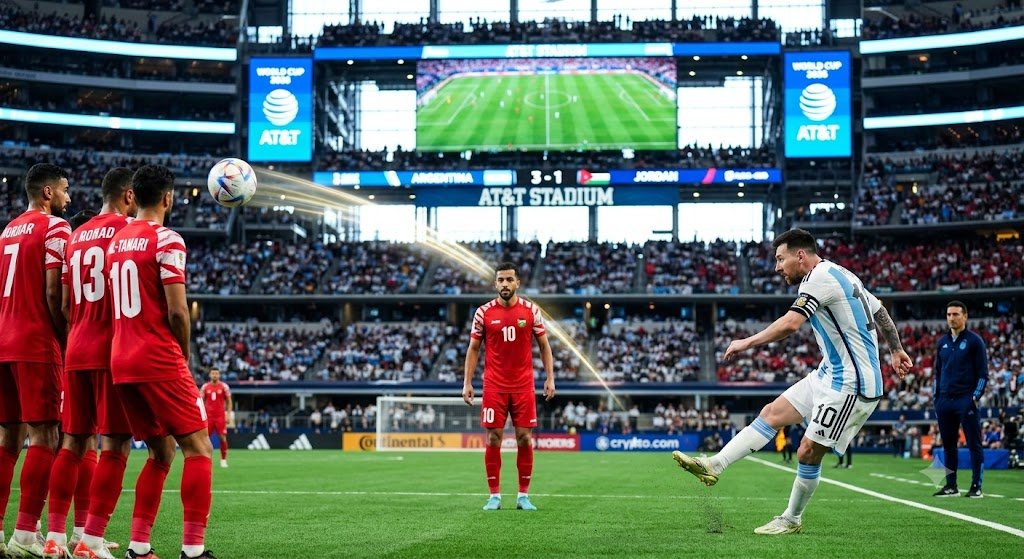
Scaloni Rested Nine Starters. Sellami Still Could Not Cope
Argentina beat Jordan 3-1 at AT&T Stadium in Arlington on June 28, 2026, finishing the group stage with a perfect nine points after Giovani Lo Celso and Lautaro Martinez scored in the first half and Lionel Messi added a late free kick from the bench. Jordan’s Mousa Al-Tamari pulled one back in between. Jamal Sellami’s side leave their first World Cup with their heads held high and their points column empty. The story tonight is not really about Jordan at all. It is about a manager who rested nine players and still cruised.
Argentina finished with 2.13 expected goals to Jordan’s 0.76, a gap that would look enormous against a full-strength World Cup champion, let alone one that had already won the group and had nothing left to play for.
Here is the decision that gets Lionel Scaloni through this group stage with his credibility untouched making nine changes and still treating the match like it mattered.
Scaloni dropped Messi to the bench entirely, kept only Emiliano Martinez and Lautaro Martinez in their regular spots, and still watched his team open the scoring through Lo Celso’s free kick in the 19th minute before doubling the lead from the penalty spot ten minutes later. That is not luck. That is a squad deep enough that the changes barely registered on the scoreline, and a manager secure enough in his group’s quality to make them in the first place. When Jordan briefly threatened a way back into the match through Al-Tamari’s 55th-minute finish, Scaloni’s response was simple: send on Messi, who needed less than twenty minutes to settle it with a trademark curling free kick that left Jordan’s goalkeeper rooted to the spot.
Sellami’s logic in making changes of his own deserves real credit, even in defeat. Bringing on Mahmoud Al-Mardi and Mousa Al-Tamari at half-time, with his side already two goals down against the reigning champions, was about generating something rather than accepting a heavy loss quietly. It worked, briefly. Al-Mardi and Ehsan Haddad combined to set up Al-Tamari’s goal in the 55th minute, cutting the gap and giving Jordan’s traveling support a moment to celebrate. The problem with that approach against this opponent is that any momentum gained tends to summon precisely the response Argentina just delivered from their bench.
The number that follows Jordan out of this tournament, even with elimination already long since confirmed before kickoff, is zero. Zero points from three group matches, conceding multiple goals in every single one, finishing bottom of a group that also contained a struggling Algeria and Austria side. Jordan at least scored in every match of their debut World Cup, which Sellami can point to with some pride. They also leave having faced the eventual group winners by an aggregate scoreline that flattered nobody wearing white.
Make no mistake, this was never a contest Jordan was supposed to win, and nobody inside their camp expected otherwise. Still, the manner of the concessions, set pieces in particular, will sting more than the scoreline. Argentina scored from a free kick, a penalty, and another free kick. Three different dead-ball situations, three different goals, against a back line that had three full days to prepare for exactly that threat.
Scaloni’s challenge now has nothing to do with Jordan and everything to do with what comes next. Cape Verde awaits in the round of 32 on July 3 in Miami, a side that has already proven itself a surprise package this tournament, and a perfect group stage means precisely nothing once the knockout rounds begin.
There is no job at risk in Buenos Aires tonight, and there never could have been one after a perfect group campaign. Sellami’s position was equally secure walking into this match and remains so walking out, since reaching a maiden World Cup was always the achievement that mattered. Scaloni leaves Arlington with the stronger hand, a deeper squad than anyone fully appreciated, and a captain who just extended his own scoring record without breaking a sweat until the seventieth minute.