
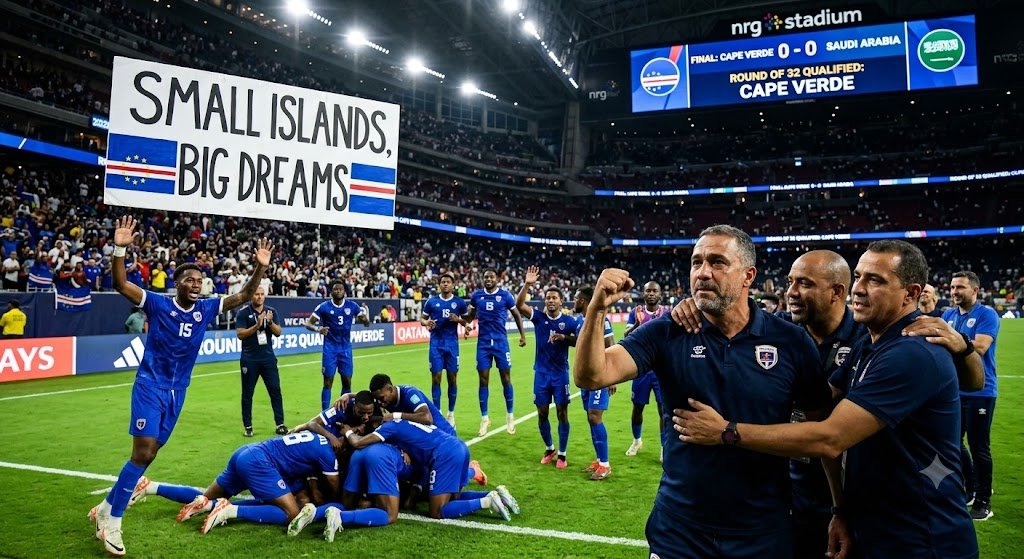
Bubista Proved Every Doubter Wrong. Now Argentina Await in 2026
Nobody is calling it luck anymore. Three matches, three draws, zero goals conceded in open play that mattered and Cape Verde are in the last 32 of the World Cup. When Bubista arrived on the touchline at NRG Stadium in Houston on June 27, 2026, his side needed a point against Saudi Arabia to confirm second place in Group H. They got it with a 0-0 draw, and then waited for Spain to finish off Uruguay in the other match. When that final whistle came through, grown men wept on a football pitch in Texas. A nation of just over 500,000 people had done something no one gave them any right to do.
Cape Verde drew Saudi Arabia 0-0 at NRG Stadium, Houston, on June 27, 2026, in their final Group H match at the 2026 World Cup. The result confirmed the Blue Sharks in second place on three points, behind Spain on seven. Saudi Arabia finished bottom on two points and go home. Cape Verde face Argentina in Miami on July 3.
The xG tells the story of who deserved to win this match. Cape Verde finished with 1.39, Saudi Arabia with 0.40. Substitute Laros Duarte had the best chance of the night a right-footed shot from the centre of the box in the 74th minute that Mohammed Al-Owais turned away. In the final seconds, Nuno da Costa dragged a shot wide in front of an open net. Cape Verde were the better side. Not by a small margin. By a significant one.
Here’s the thing the decision Bubista got most right was not tactical at all. It was psychological.
Strip away the noise and his setup was clear from the first minute against Spain: compact, disciplined, with Kevin Pina sitting deep in front of the defence to protect João Paulo’s overlapping runs from left back. That shape held through three matches against a 2010 world champion, a South American heavyweight, and a side that had beaten Argentina at the last World Cup. Not one of those opponents found a way through it cleanly. Saudi Arabia managed an xG of 0.40 across 90 minutes. That is not a defensive system under pressure. That is a system working exactly as intended.
His substitutions against Saudi Arabia were also well-read. At 61 minutes, with the match tight and Saudi Arabia still threatening, Bubista brought on Helio Varela and Nuno da Costa simultaneously. Da Costa had scored the equaliser against Uruguay. Varela had set it up. Introducing both of them at the same moment forced Saudi Arabia to rethink their entire defensive shape. By the 71st minute, Laros Duarte and Garry Rodrigues were also on four fresh legs in the final half hour, all with specific jobs. Cape Verde’s best chances all came after those changes. The bench did not disrupt the structure. It sharpened it.
Vozinha made three saves. He is 40 years old and has more than 16 million Instagram followers because of this tournament. His stop from Mohamed Kanno’s header in first-half stoppage time was the moment that kept the clean sheet alive when Saudi Arabia were at their most dangerous. Two more saves followed. Every single one was clean, calm, and well-positioned. He did not need to be spectacular because the defence in front of him gave him so little to deal with but when he did need to act, he did it without drama. That is what good goalkeeping looks like.
Saudi Arabia’s Roberto Mancini, on the other hand, faces questions he cannot easily answer. His side created an xG of 0.40 across three group stage matches combined in terms of attacking threat against Cape Verde alone a team ranked far below them and committed 16 fouls in the process, picking up three yellow cards. Salem Al-Dawsari, the captain, was substituted at the 66-minute mark having contributed almost nothing going forward. The logic of starting him was sound: he is experienced, he can carry the ball, and Saudi Arabia needed a goal. But he never found space, never drove at the defence, and the decision to wait until the 66th minute to replace him cost his side any real momentum in the second half.
Make no mistake, Mancini’s broader problem runs deeper than one substitution. Saudi Arabia were physically direct but offered almost nothing creative through the middle. They had 20 touches in the opposition box to Cape Verde’s 19 roughly even but their shots were largely speculative, with an average xG per shot that never challenged Vozinha seriously. They could not break down a back four built around Diney Borges and Pico Lopes, two defenders who spent the evening winning headers, clearing early, and keeping shape under pressure. Saudi Arabia’s attack could not find a single moment of genuine quality in the final third.
The result and performance Mancini carries away from Houston are hard to separate. Two points from three group games, a goal difference of minus four across the tournament, and an exit against a side making their World Cup debut. He will not enjoy the conversation that follows. Nor should he.
Bubista leaves Houston in a stronger position than almost anyone in world football could have predicted three weeks ago. He is preparing for Argentina. He is preparing for a back four that includes three of the best centre-backs alive. He is preparing for Lautaro Martinez, Julian Alvarez, and a side that will not sit as deep as Saudi Arabia did. His counter-attacking shape will be tested harder than it has been all tournament, and a 0.40 xG conceded performance will not be enough against the world champions.
But that is a problem for July 3. Tonight, on a football pitch in Texas, Bubista’s players collapsed into each other and cried, and the sign in the stands read “Small Islands, Big Dreams.” He put them there. All of it the shape, the substitutions, the belief was his doing.