
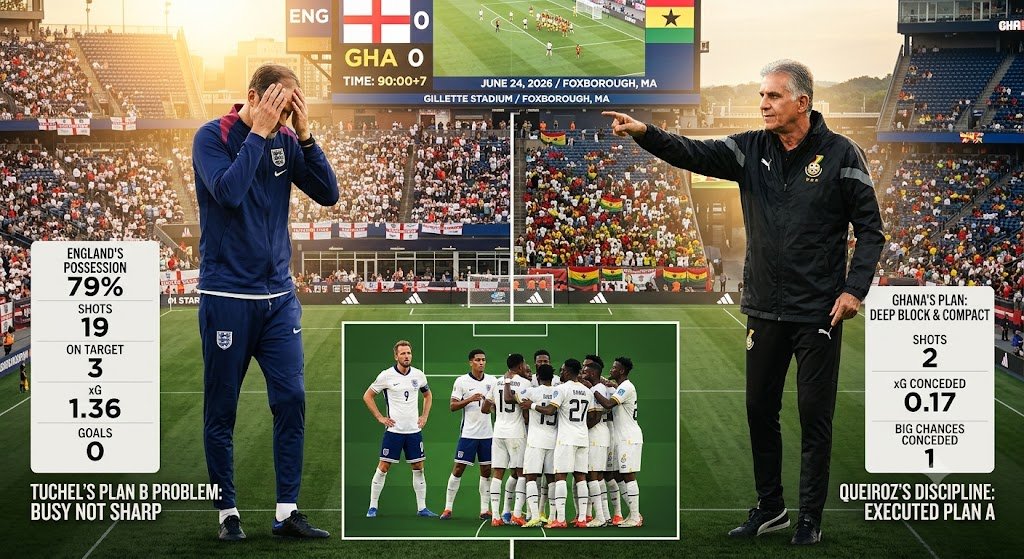
Tuchel Has a Plan B Problem That Will Not Wait
England drew 0-0 with Ghana at Gillette Stadium in Foxborough on June 24, 2026, in their second Group L match, a result that leaves both teams on four points but raises a question Thomas Tuchel cannot put off until the knockouts. Nineteen shots, only three on target, and 1.36 expected goals that produced exactly nothing. When a possession share of 79 percent buys you this little, the problem is not effort. It is method.
This was the first match of the tournament to reach half-time without a single shot on target from either side. England finished with 1.36 expected goals to Ghana’s 0.17, numbers that confirm what the eye test already suggested: one team dominated territory completely and still could not find a way through.
Here is the question Carlos Queiroz answered correctly and Tuchel did not. Queiroz built his entire gameplan around sitting deep, staying compact, and inviting England to pass around a well-organized block without ever truly threatening it. It worked for the full ninety minutes plus seven of stoppage time. Ghana managed only two shots all match, worth a combined 0.17 expected goals, and conceded just one big chance despite facing 586 accurate passes and 33 touches in their own box. That kind of discipline against a team that scored four goals in its opening match is not an accident. It is a manager who identified his side’s only realistic path to a result and executed it without wavering, even when England poured bodies forward in the final twenty minutes.
Tuchel’s decision to make wholesale attacking changes, throwing on Saka, O’Reilly, Rogers, Eze, and Rashford across the final thirty minutes, was not unreasonable in isolation. Facing a team sitting this deep, fresh legs and direct running made obvious sense. The trouble is that five changes arriving in waves rather than as a coordinated shift in approach left England’s attack looking busier rather than sharper. O’Reilly’s header struck the crossbar in stoppage time and Harry Kane somehow skied the rebound from close range, the kind of moment that summarizes an evening where chances eventually arrived but conversion never did.
The stat that follows Tuchel into the final group match against Panama is brutal in its simplicity. Only three of nineteen shots hit the target. A team monopolizing 79 percent of possession and 93 percent passing accuracy still managed a shooting conversion rate that would embarrass a Sunday league side. Bellingham, Kane, and Rice all had half chances in the first half alone and could not test Benjamin Asare even once before the break.
Make no mistake, this was not bad luck stacking up over ninety minutes. It was a structural problem repeating itself, chance after chance, with no real variation in how England tried to break Ghana down.
Queiroz now faces the sharper test. Ghana finish the group stage against Croatia, a side considerably more dangerous in behind than the version England’s deep block frustrated tonight, and Queiroz cannot rely on quite the same level of passivity from his opponent. Sitting this deep against a team that will look to counter just as eagerly invites a different kind of risk entirely.
Neither manager’s job carries any real pressure after this result. Both sides remain firmly inside the qualification picture with one match left, and a draw against a well-drilled opponent is not the stuff of crisis meetings. Still, Queiroz leaves Foxborough in the stronger position. His plan worked exactly as designed against a side many expected to score three or four. Tuchel leaves with a result that will not cost him his job but will cost him sleep, because a team that cannot break down a deep block in the group stage will not get an easier version of that puzzle in the knockouts.