
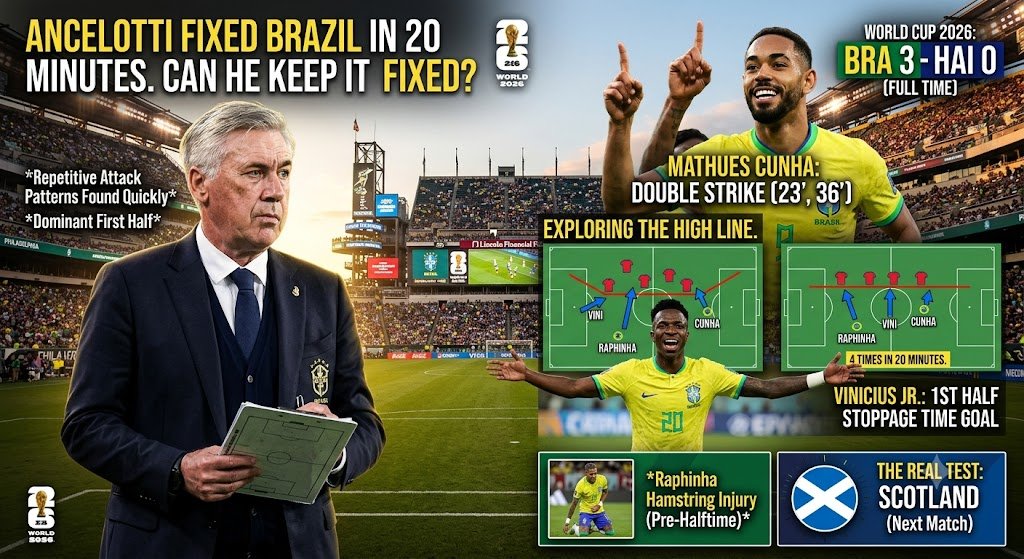
Ancelotti Fixed Brazil in Twenty Minutes. Can He Keep It Fixed?
Carlo Ancelotti’s team looked nothing like the side that drew with Morocco five days earlier, and the shift happened almost on command. Brazil beat Haiti 3-0 at Lincoln Financial Field in Philadelphia on June 20, 2026, in their Group C match at the 2026 World Cup, eliminating Haiti from contention and moving top of the group on goal difference. The question for Ancelotti now is not whether his attack can score. It is whether he can make this version of Brazil show up against teams that actually fight back.
Here is the direct answer. Matheus Cunha scored in the 23rd and 36th minutes. Vinicius Junior added a third in first-half stoppage time. All three goals came inside 45 minutes, and Brazil controlled the rest of the match without ever needing to find a fourth gear.
Make no mistake, this performance answers almost nothing about the bigger question hanging over this Brazil squad, because Haiti made it too easy.
Start with what worked, because it worked clearly. Ancelotti’s front three of Cunha, Vinicius, and Raphinha attacked the space behind a high Haiti back line that pushed up without the pace to recover. Raphinha had two efforts chalked off for offside inside the first 22 minutes alone, both correct calls, both signs that Brazil had already found the gap they wanted. When Cunha finally converted in the 23rd minute, it was not a fluke read. It was the fourth time in twenty minutes Brazil had found the same route through.
The second goal confirmed it. Haiti lost possession in midfield, Vinicius slid Cunha through on the left, and the Manchester United forward smashed it into the roof of the net. Two goals, one pattern, one defense that never adjusted.
Then a problem arrived that Ancelotti did not choose. Raphinha went off just before halftime with what looked like a hamstring issue, and the timing could not be worse with Scotland up next in a match that may decide the group. Losing him forced nothing tactically tonight, since Brazil were already 2-0 up and cruising, but it is the one item from this match that follows the manager into the week ahead regardless of the scoreline.
Frantz Migne’s logic for sitting Haiti deep and compact was sound on paper. A team with no realistic path past the group stage protects its goal difference and waits for set pieces or mistakes. The flaw was personnel, not plan. Haiti’s back five kept stepping up together rather than dropping as a unit, and Brazil’s front three are simply too sharp in behind for that to survive three different runners attacking it.
Here is the thing about Haiti’s night. For all the damage, Haiti still forced Alisson Becker into a real save before the hour mark, when Ricardo Ade headed a corner goalward and the goalkeeper got down quickly to deny what would have been Haiti’s first World Cup goal since 1974. Wilson Isidor drew another good stop from distance late on. Migne’s team did not collapse after the break. They simply had no way back from three goals down against opponents who stopped pressing once the job was done.
For Ancelotti, the harder test starts now. Brazil have scored five goals across two matches but managed only one of them in a game where the opponent actually pushed back, the Morocco draw, and Scotland will not sit as deep or as passively as Haiti did. Cunha and Vinicius punishing a high line is one skill. Breaking down a side that refuses to give Brazil the same space is a different problem entirely, and Ancelotti has not yet had to solve it.
Ancelotti leaves Philadelphia with three points, a healthier goal difference, and one significant injury concern hanging over his best two-way wide forward. Migne leaves with his team eliminated but with more defensive resistance shown after halftime than the scoreline suggests. The job pressure sits entirely with Ancelotti now, not because of tonight’s result, but because of what comes next. Scotland will ask the question Haiti never could.