
De La Fuente Just Answered Every Question About Spain at the 2026 World Cup
Everyone wanted to know if Luis de la Fuente had a plan B. After the Cape Verde draw, the Spanish press were circling. Forty-eight hours of noise about a coach who had supposedly got too cute, too cautious, too married to a system that could not unlock a well-organized low block. De la Fuente stayed quiet through most of it. On Sunday night at Mercedes-Benz Stadium in Atlanta, his team did the talking instead.
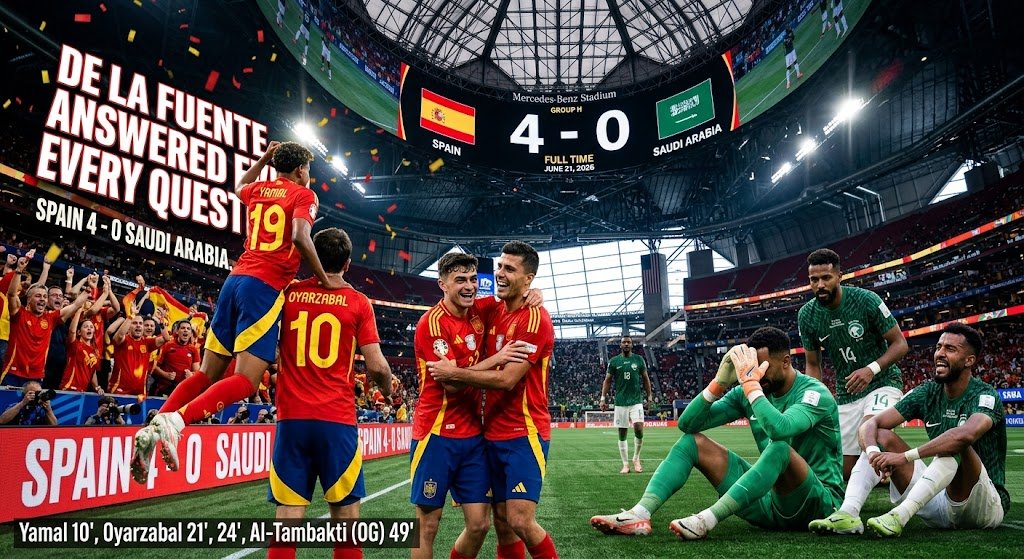
Spain beat Saudi Arabia 4-0 in Group H on June 21, 2026, with goals from Lamine Yamal in the 10th minute, Mikel Oyarzabal in the 21st and 24th, and an own goal from Hassan Al-Tambakti in the 49th. Saudi Arabia finished with an xG of 0.14. Spain’s was 2.30. These are not numbers that invite debate.
Strip away the noise and there are really two coaching stories from this match. One is about a manager who made two calls before kick-off that changed everything. The other is about a manager who had no answers, made eight substitutions across both halves, and leaves Atlanta knowing his team’s World Cup survival depends entirely on a result they do not control.
De la Fuente started Yamal from the beginning.
That sounds simple. It was not. Yamal had missed the end of the Barcelona season with a hamstring injury and came off the bench against Cape Verde, which told you exactly how cautious Spain’s medical and coaching staff were being. Starting him here, in a match Spain absolutely needed to win, was a calculated risk. It paid off inside ten minutes, when Yamal slid in at the far post to turn Oyarzabal’s low cross home from five yards. A 0.28 xG chance, converted. The crowd, already buzzing from Yamal’s warm-up appearance alone, went electric.
Here is the thing the more telling decision was what de la Fuente did with Oyarzabal. The Real Sociedad striker had been savaged after the Cape Verde draw, specifically for touching the ball so rarely in the opening thirty minutes. Rather than dropping him, de la Fuente kept faith. Oyarzabal responded by providing the assist for the first goal and then scoring twice himself, at the 21st and 24th minutes, both from inside the box. He also hit the crossbar. He also missed a clear-cut chance that would have brought a hat-trick. By the time de la Fuente pulled him at half-time with the match already settled, Oyarzabal had done everything but score three. That is a coach reading his player correctly: not dropping him, not over-protecting him, just trusting him to be good enough.
Pedri’s six interceptions were the most by any player in a single match at this tournament. Rodri completed 119 passes. Spain had 37 touches in the Saudi Arabia box to their opponents’ two. These are not just numbers they tell you this was not a flattering scoreline. Spain were genuinely dominant, and the system de la Fuente set up gave his best players room to function at a level they had not been allowed to reach four days earlier.
Saudi Arabia’s Herve Renard wait. Saudi Arabia’s bench boss in Atlanta was Roberto Mancini’s successor, and the structural problems he faces go well beyond one bad afternoon. A 5-4-1 shape that was designed to frustrate gave Spain far too much space in behind from the first whistle.
Saudi Arabia had zero big chances, zero crosses that found a teammate, and two yellow cards. The only bright moment for the Green Falcons across ninety minutes was Mohammed Al-Owais, who made five saves and prevented what could realistically have been six or seven. A keeper posting a goals-prevented figure of -0.55 meaning he kept out more than half a goal’s worth of expected goals is the definition of a man carrying a team.
Saudi Arabia made eight substitutions in total, four at half-time. That level of change mid-game is rarely a sign of a coach in control. More often it is a coach reacting. The tactical adjustments after the break made little difference to Spain’s rhythm, and when the fourth goal arrived in the 49th minute Al-Tambakti turning Cucurella’s shot into his own net from three yards the match was over as a contest. Saudi Arabia need to beat Cape Verde in their final group game to have any realistic chance of progressing. A side that has now conceded four to Spain and managed 0.14 xG in the process will need to find something fundamentally different to have any chance of doing that.
De la Fuente, by contrast, is not entirely off the hook. Spain face Uruguay next, a side that has looked more dangerous across their two draws than their points total suggests, and the question of what happens when Spain come up against a genuinely organized, athletic defensive unit will resurface. Rotating both Yamal and Oyarzabal out at half-time was the right call tonight but tells you those players are still being managed physically. They cannot be rested in the knockout rounds.
Make no mistake: de la Fuente answered his critics tonight. Completely, and with some style. Whether the questions stay answered is a different conversation.