
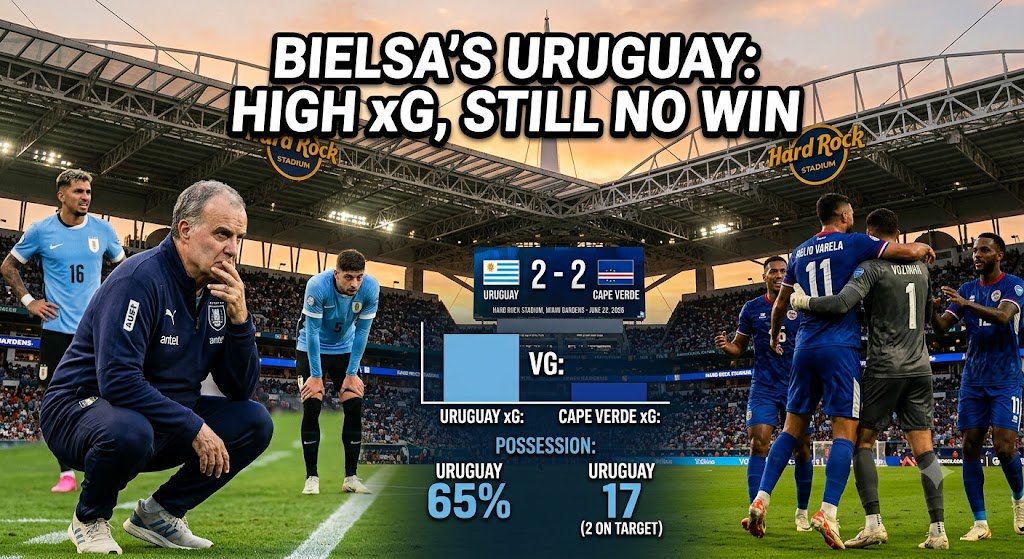
Bielsa Scored 2.32 xG and Still Cannot Win a Game at the 2026 World Cup
Uruguay drew 2-2 with Cape Verde at Hard Rock Stadium in Miami Gardens on June 22, 2026, in their Group H match at the 2026 World Cup. Kevin Pina fired Cape Verde ahead in the 21st minute, Maxi Araujo equalised in the 44th and Agustin Canobbio put Uruguay in front in first-half stoppage time, before substitute Helio Varela levelled for Cape Verde in the 61st. Both teams sit on two points. Uruguay face Spain next. Cape Verde face Saudi Arabia.
Everyone will focus on Varela’s goal the substitute who scored two minutes and sixteen seconds after coming on, the fastest goal by an African substitute in World Cup history since Roger Milla in 1994. It is a brilliant footnote. It is not the real problem for Marcelo Bielsa.
The real problem is this: Uruguay generated 2.32 xG in Miami and did not win the match. That number is not a near miss. That is a performance that, on almost any other evening against almost any other opponent, wins you the game comfortably. Against a Cape Verde side making its World Cup debut, with 65 percent possession, 34 touches in the opposition box to Cape Verde’s ten, and 11 corners to their four, Uruguay should not be drawing. They are not drawing because of Cape Verde’s brilliance. They are drawing because of their own wastefulness and a moment of defensive carelessness so bad it barely deserves analysis.
Here is the thing Bielsa’s best decision in this match was also the one that exposed him most. He set Uruguay up to dominate territorially and they did exactly that, particularly in the first half. Federico Valverde drove the game from midfield, Araujo found intelligent positions out wide, and Uruguay built pressure in waves. When Araujo headed home from close range in the 44th minute and Canobbio tucked in a second in stoppage time, the structure of the performance had produced exactly what it was supposed to. Two-time World Cup winners going in at half-time 2-1 up against a team making their finals debut, with the better xG, the better chances, the better shape. All of that was Bielsa’s plan working.
Then Mathias Olivera played a sideways pass across his own box in the 61st minute that neither reached a teammate nor went anywhere safe, and Helio Varela literally seconds after stepping off the bench rolled the ball into an empty net past a stranded Fernando Muslera. That single moment undid everything the first half had built. Bielsa cannot be blamed for Olivera’s error. But he can be questioned on what followed.
After going level, Uruguay pushed hard and went close on several occasions, with Valverde’s stoppage-time free-kick going just over and Darwin Nunez brought on in the 70th minute creating a clear chance for Canobbio that was missed wide in added time. The problem was not effort. The problem was composure. Seventeen shots, only two on target. That conversion rate roughly 12 percent is the number that will trail Bielsa into his preparation for Spain.
For all the talk about Cape Verde’s defensive organisation, credit must go to the coach who set it up. Their 4-1-4-1 sat deep, pressed at the right moments, and made Uruguay work through wide areas where the danger was limited. Pico Lopes made clearance after clearance in the second half he had already led all players in clearances against Spain in the opener and the defensive line held its shape despite sustained pressure late on. Cape Verde’s manager understood that denying Uruguay central access would force Bielsa’s attackers into low-percentage deliveries, and that is precisely what happened. Uruguay had four accurate crosses all match. Four. Against a side with no World Cup experience before this tournament, that is a tactical win for Cape Verde regardless of what the possession stats say.
The substitution that brought Helio Varela on in the 58th minute, straight off the bench and into an immediate goal, will be remembered as decisive. Sending fresh legs against a tiring Uruguay backline was smart management at exactly the right time.
Still, Cape Verde are not yet through either. A point against Saudi Arabia might be enough, but it is not guaranteed. Their manager leaves Miami in the stronger position two draws against Spain and Uruguay, unbeaten, still in control of their own fate. That is a remarkable statement for a team making its first World Cup appearance.
Bielsa leaves in a far darker place. His job is not under immediate threat Uruguay’s federation is not the type to panic after a group stage draw but the pressure is significant. Two draws from two matches. Spain next, who just beat Saudi Arabia 4-0. Uruguay need a win to be certain of progressing, and their forwards have not yet shown they can take the chances that their xG says they deserve. Valverde can generate all day. Someone has to finish.
Uruguay were the better side across 90 minutes. Full stop. And yet the point belongs equally to both teams, and Spain awaits. That is Bielsa’s problem, and it is not a small one.