
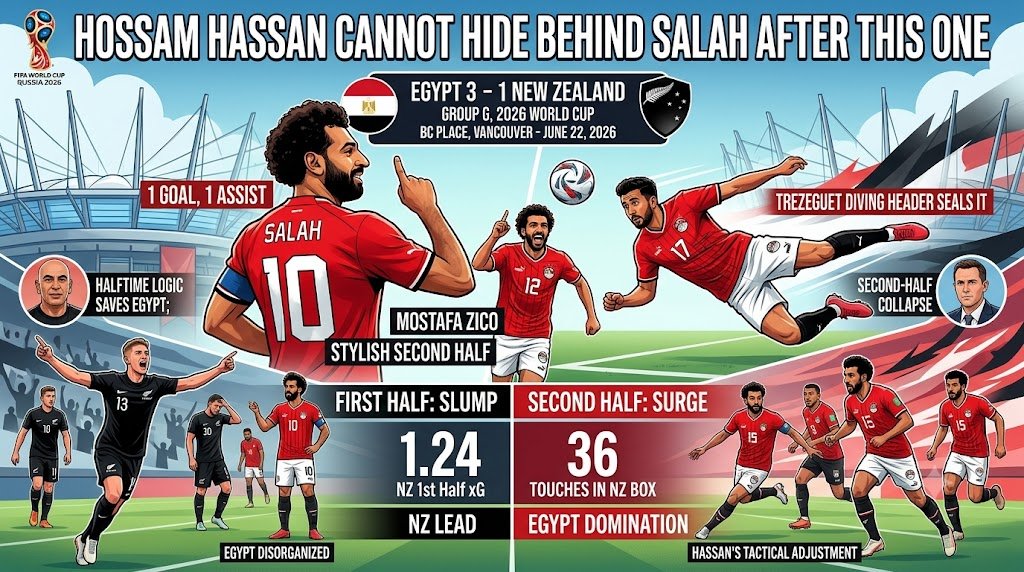
Egypt beat New Zealand 3-1 at BC Place in Vancouver on June 22, 2026, in their Group G match at the 2026 World Cup. Mostafa Zico equalised in the 58th minute, Mohamed Salah put Egypt ahead in the 67th, and Trezeguet sealed it with a diving header in the 82nd. Hossam Hassan’s side are top of Group G with four points. New Zealand sit bottom with one.
Everyone will spend the next few days talking about Salah. One goal, one assist, a standing ovation when he came off in the 85th minute, and another record in his sights he is now one behind Hassan himself on Egypt’s all-time scoring list. The story writes itself. It is also only half the story.
Here is the one the managers will both be thinking about: Egypt were losing at half-time to a New Zealand side that had generated 1.24 xG against them and created three big chances to Egypt’s two. Strip away the noise and Hassan’s team spent roughly 40 minutes playing well below what they are capable of, got outworked in the first half by a side ranked far below them, and needed a significant second-half adjustment to turn the match around. They won. They deserved to win, eventually. But the scoreline flatters the quality of the performance, and Hassan knows it.
Make no mistake, the half-time interval was the most important tactical moment in this match. Egypt came out of the break pressing higher, moving the ball faster, and committing more numbers into the attacking third. Their touches inside the New Zealand box went from almost nothing in the first half to 36 by full-time. That is not an accident. Hassan pushed Salah and Marmoush into closer positions to the New Zealand back four, and the result was immediate — Egypt had five clear attempts in the first ten minutes of the second half before Zico finally headed one in from Mohamed Hany’s cross in the 58th minute. Zico had been Egypt’s most dangerous player all evening, and Hassan had been right to persist with him despite the first half going nowhere.
The Zico substitution at the 76th minute was smart management. He had scored once, assisted once, and given a lot. Bringing on Trezeguet for Marmoush at the same time was even smarter Trezeguet had been on the pitch for six minutes when he dived to meet Salah’s corner and fired in the third. Rotating without losing momentum is something not every coach gets right. Hassan got it right here.
New Zealand’s coach Darren Bazeley is the one who will not sleep well. His team’s first half was genuinely good. Finn Surman’s header from Tim Payne’s corner in the 15th minute was exactly the kind of structured set-piece goal a lower-ranked side needs to execute to stay in a game. New Zealand pressed, stayed compact in shape, and forced Egypt into a disjointed opening 45 minutes. The xG numbers backed them up. For a team that drew with Iran in its opener after twice taking the lead, there is something real developing here.
And then it fell apart.
After the restart, New Zealand dropped too deep and stopped pressing altogether. Their 14 fouls compared to Egypt’s eight tells part of the story — they were chasing the ball rather than winning it. Callum McCowatt had a decent header blocked in the 52nd minute that could have made it 2-1, but Bazeley’s response to that near-miss was to substitute McCowatt off at the 66-minute mark, just as New Zealand needed creativity most. Bringing Ben Old on in his place did not change the game’s direction at all. By then Egypt were already beginning to control the second half, and New Zealand had effectively stopped threatening.
Truth is, the decision to pull McCowatt when Egypt were level and pressing harder was the moment Bazeley effectively accepted defeat. There was no tactical shift, no attempt to give New Zealand a different shape or a different threat. Egypt kept coming, Salah kept finding space in the channels, and the scoreline moved in one direction. New Zealand’s 1.24 xG is the number Bazeley takes into the final group game against Belgium. That is enough to score in most matches. It was not enough to win this one and the second-half collapse is entirely on how the team was managed when the game turned.
New Zealand are out unless something extraordinary happens against Belgium. Egypt need only a draw against Iran in Seattle to go through. One manager travels to his final match looking for a lifeline. The other has the luxury of rotating, resting Salah if he chooses, and planning for the knockout round.
Hassan leaves Vancouver in the stronger position. No question. But a team that concedes the opening goal of a World Cup match to a New Zealand corner and then spends 45 minutes looking disorganised is not yet ready to face the teams that await in the last 16. He should be grateful for the result. He should also be honest about what the first half said about his side because the teams coming next will not give him that kind of half-time reprieve.