
Mexico Are Through and Aguirre Still Cannot Tell You How Good They Are in 2026
Javier Aguirre knows. He said it himself after the final whistle at Estadio Akron in Guadalajara it was difficult, the opposition gave them nothing, and in the end one mistake was always going to settle it.
That is an honest assessment. It is also a quiet admission that Mexico, six points from six, winners of Group A, the first side confirmed for the knockout stage of the 2026 World Cup, are not yet a team that can explain their own ceiling.
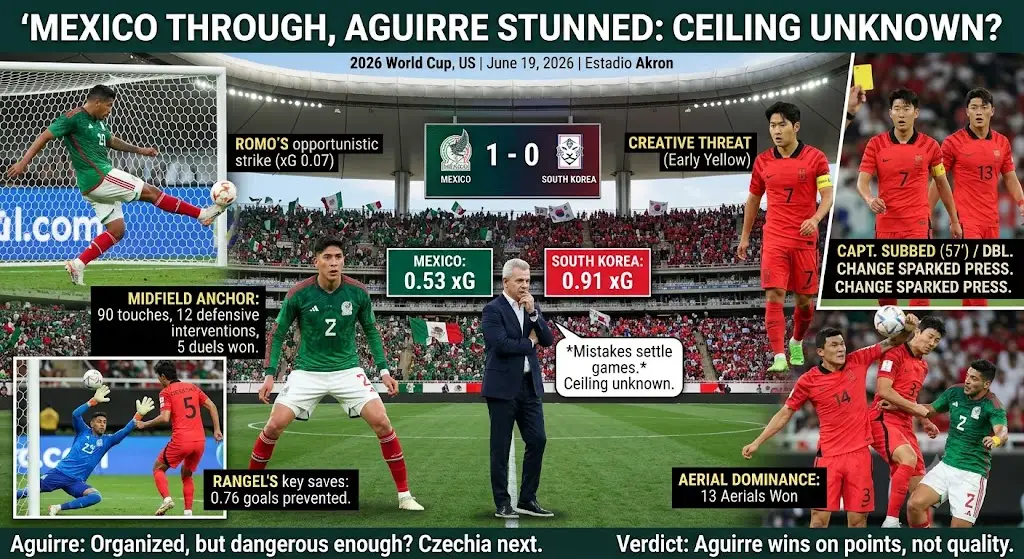
Mexico beat South Korea 1-0 on June 19, 2026, at Estadio Akron in Guadalajara in their Group A match, through a Luis Romo finish in the 50th minute.
Mexico had an xG of 0.53. South Korea finished with 0.91. The team that generated more danger lost. That is the scoreline. That is also the problem for Hong Myung-bo and, in a different way, for Aguirre too.
Romo’s goal was opportunistic rather than designed. Julian Quinones delivered a cross from the left, goalkeeper Kim Seung-gyu collided with defender Lee Gi-hyuk inside the box and spilled it, and Romo was in the right place to volley the loose ball into an empty net from fifteen yards. An xG of 0.07 for the decisive moment. Mexico did not carve South Korea open. They punished a mistake, held firm, and won.
Aguirre’s best call was structural and came before kick-off. Setting up in a 4-3-3 against South Korea’s 3-4-2-1 gave Mexico a numbers advantage in central midfield that they used well enough to stay compact and prevent Lee Kang-in from finding the spaces he needed between the lines. Edson Alvarez was the anchor 90 touches, 12 defensive interventions,
5 duels won and gave Aguirre exactly what he needed in that position. Erik Lira and Romo beside him kept the shape tight. For fifty minutes it produced nothing going forward, but it produced nothing going backward either, and in a match this tense that was worth something.
Still, the number that follows Aguirre into the knockout stage is uncomfortable. South Korea created two big chances. Mexico created one.
A side that has won every match in this tournament two from two, top of the group, playing at home has generated less danger than both opponents across the full 180 minutes. That is not a minor footnote. That is a pattern.
For Hong Myung-bo, the tactical logic of the first fifty minutes was clear and not without merit. South Korea sat in their 3-4-2-1, used Kim Min-jae and Lee Han-beom to dominate aerially 13 aerials won to Mexico’s 15, remarkably close for a side that outmatched Mexico in possession and waited for moments on the counter. Lee Kang-in was booked inside four minutes, which hurt. Son Heung-min was not sharp and came off at the 57th minute.
Losing both your primary creative threat to a yellow card restriction and your captain to substitution before the hour is an accumulation of problems no tactical setup fully survives.
Make no mistake: Hong’s double substitution at 57 minutes bringing on Oh Hyeon-gyu and Hwang Hee-chan simultaneously changed the character of the match. From that point South Korea pressed higher, created their best moments, and in the 87th minute produced two clear chances in the same passage of play. Cho Gue-sung headed directly at Raul Rangel from close range; Yang Hyun-jun’s follow-up from inside four yards was pushed away at full stretch. Two saves, both sharp, both ones Rangel had no right to make at that speed. South Korea were the more dangerous side across the final thirty minutes. They will know it. Hong will know it.
Rangel’s goals-prevented figure of 0.76 is the number Hong will carry into the South Africa game. Rangel did not just make saves he prevented the result from being entirely different. South Korea’s 0.91 xG against a team defending a lead for forty minutes says they created enough. Mexico’s goalkeeper disagreed.
Here is the thing Aguirre now faces a genuinely awkward question heading into the knockout rounds. His side have qualified. His first-choice striker, Raul Jimenez, is being managed carefully and came off in the 80th minute.
Santiago Gimenez, who replaced him, is arguably the more dangerous option at this point in their careers. Against Czechia, Aguirre will need to decide whether to keep resting players or to push for a performance that builds real momentum. Six points and no convincing football is a fine position to be in. Against a knockout opponent, fine will not be enough.
Hong Myung-bo leaves Guadalajara as the coach under more pressure, but not as one who has run out of ideas. South Korea need a point against South Africa to be almost certain of progressing. A side that generated 0.91 xG against Mexico’s well-drilled defense, that made six changes and still found threatening moments late, has something to work with.
Verdict: Aguirre wins this one on points, not on quality. Mexico are through, organized, and difficult to beat.
They are not yet dangerous enough to frighten anyone. Hong, by contrast, leaves having outperformed the scoreline and with enough evidence to believe his side can still make the knockout stage.
One point will probably do it. Whether Mexico can produce something more convincing when the tournament actually matters that is the question neither Aguirre’s results nor his performances have yet answered.