
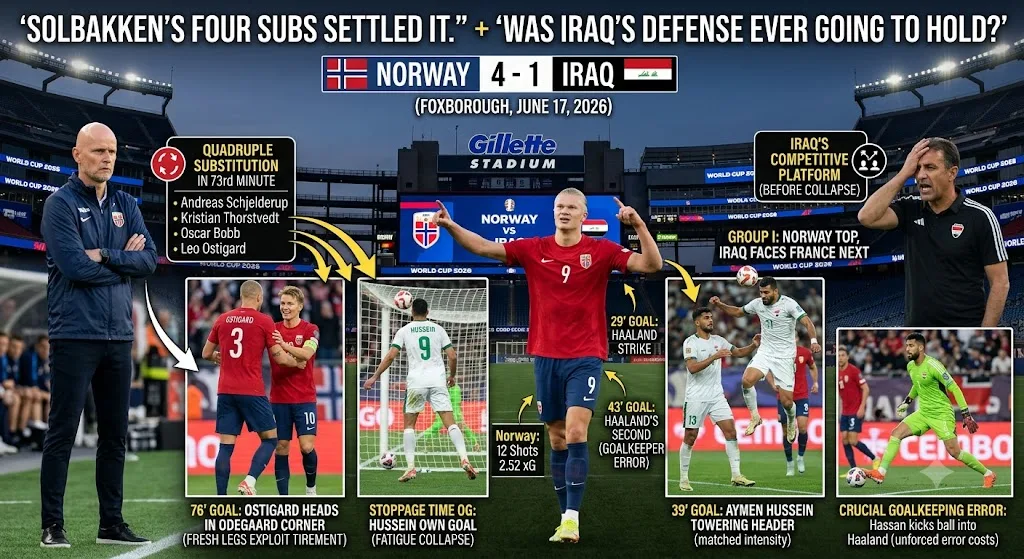
Solbakken’s Four Subs Settled It. Was Iraq’s Defense Ever Going to Hold?
Stale Solbakken made four substitutions inside a single minute, and Norway scored twice more after the changes landed. Norway beat Iraq 4-1 at Gillette Stadium in Foxborough on June 17, 2026, in their Group I opener at the 2026 World Cup, and the gap between the two benches in the final half hour explains the scoreline far better than the opening goal did.
Here is the direct answer. Erling Haaland scored twice for Norway, in the 29th and 43rd minutes. Aymen Hussein leveled for Iraq in the 39th with a header. Leo Ostigard added a third in the 76th, and Hussein turned the ball into his own net in stoppage time for Norway’s fourth. Norway move top of Group I level on points with France, while Iraq sit bottom with zero points and now face tournament favorites France next.
Make no mistake, the four-minute spell of substitutions in the 73rd minute is the real story of how this got to 4-1, not Haaland’s opening goal.
Start with what worked for Solbakken, because the timing was precise rather than reactive. With Iraq still alive at 2-1 and pushing for an equalizer, sending on Andreas Schjelderup, Kristian Thorstvedt, Oscar Bobb, and Leo Ostigard together refreshed every attacking line at once rather than patching one position. Ostigard, a center back thrown forward, rose unmarked to head in Martin Odegaard’s corner just three minutes after entering. Thorstvedt nearly added another moments later. That is not luck. That is fresh legs exploiting a defense that had already given everything it had for seventy minutes.
Here is the thing about that substitution wave. It did not just add energy. It added height and movement specifically aimed at a back line that had already conceded from a corner-adjacent header once before in the match.
Iraq’s manager deserves real credit for the platform his team built before that collapse. Pressing Norway high and breaking with purpose produced the equalizer itself, a well-worked move through Ali Jasim and Amir Al-Ammari that ended with Hussein’s towering header beating Jalal Hassan. For thirty nine minutes, Iraq matched Norway’s intensity and got the goal their effort deserved. The flaw was not the approach. It was that Iraq had nothing left in the tank once Norway’s fresher players started arriving, and the back line that held for most of the first half could not hold for the final twenty minutes.
The moment that follows Iraq’s coach into the France match is not really about tactics at all. It is about goalkeeper Hassan failing to deal with a routine back pass just four minutes after his own team had equalized, accidentally launching the clearance straight into Haaland for what became Norway’s second. That kind of unforced error against a team already missing chances at a high rate is the type of moment that costs results regardless of game plan.
For Solbakken, the challenge ahead is converting underlying numbers into more comfortable matches earlier. Norway out-shot Iraq twelve to eleven but needed 2.52 expected goals to truly pull away, and Senegal awaits next in a group now wide open after France’s own opening result. Haaland missed a clear hat trick chance late on, denied by a good Hassan save, and that wastefulness in front of goal will matter more against opponents who do not eventually collapse.
Solbakken leaves Boston with three points, a healthy goal difference, and a bench that delivered exactly when the legs on the pitch ran out. Iraq’s coach leaves with real signs of competitiveness undone by fatigue and one bad goalkeeping moment. Solbakken’s job looks safe and sharp. Iraq’s coach now has to find energy reserves his team simply did not have tonight.