
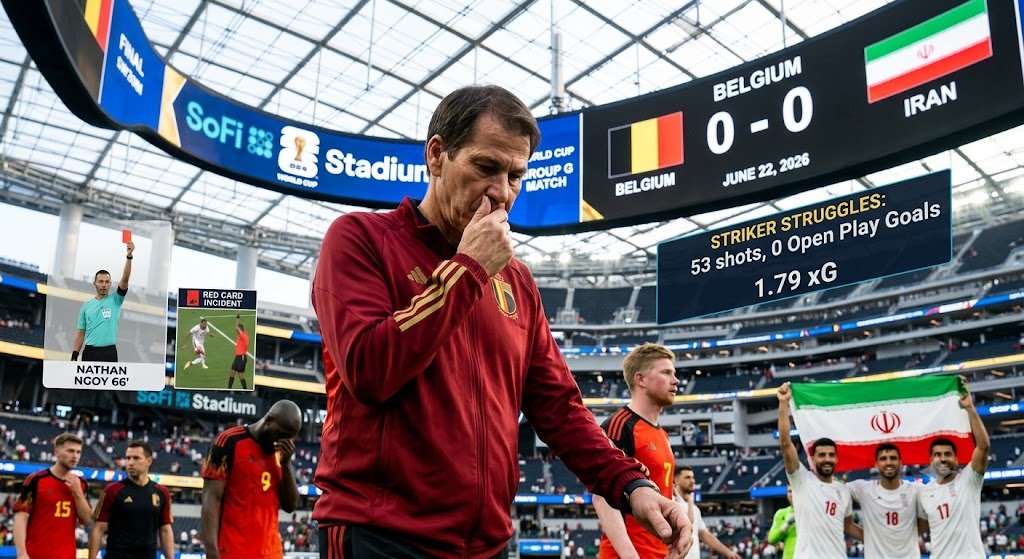
Rudi Garcia Cannot Blame Anyone Else for This 2026 World Cup Disaster
Everyone will point at Nathan Ngoy’s red card as the reason Belgium did not beat Iran. That is the easy read. It is also wrong.
Belgium drew 0-0 with Iran at SoFi Stadium in Inglewood, California on June 22, 2026, in their Group G match at the 2026 World Cup. They had 70% possession, generated 1.79 xG, attempted 23 shots, and still could not score. The red card did not cost them. They were already failing before Ngoy dragged Mehdi Taremi down in the 66th minute. A team that cannot convert 1.79 xG against a side ranked nowhere near them does not have a red card problem. It has a coaching problem.
Belgium are now 53 consecutive shots at the 2026 World Cup without a goal from open play the only goal they have scored across two matches came via an own goal against Egypt. They sit second in Group G on two points, level with Iran, and below Egypt’s four. Rudi Garcia has one match left to save his tournament.
Strip away the noise and the real story here is tactical, and it starts in the dugout.
Garcia came into this match with Romelu Lukaku in the starting eleven, despite the striker having missed most of his club season at Napoli with a hamstring injury and having only played as a substitute in the first game. The logic was understandable: Lukaku is Belgium’s career goalscorer, the man you want in the box when nothing is going in. But he managed one shot in 73 minutes, contributed almost nothing to Belgium’s build-up, and his presence in the system seemed to rob the attack of any real movement in behind. Garcia substituted him off at 73 minutes, replacing him with a defender in Arthur Theate, which told you everything about what the manager now feared more than he wanted to win.
Here is the thing the more damaging call came at the 58th minute, when Garcia withdrew Alexis Saelemaekers, who had been arguably Belgium’s sharpest ball-carrier in the first half. The commentators called it strange at the time. Strange is generous. Saelemaekers had been causing problems on the right side, linking well with Kevin De Bruyne and pressing with genuine energy. Removing him for Dodi Lukebakio disrupted the only rhythm Belgium had built. Lukebakio came closest to scoring his late effort bent narrowly past Beiranvand’s upright but the substitution still removed the one player who had made the Belgian attack look coherent.
Three substitutions at once on the hour mark is a clear sign of a manager who knew his plan had not worked. Garcia made those changes before the red card changed the game. That matters.
Amir Ghalenoei, meanwhile, left SoFi Stadium in a far stronger position despite never winning this match. His decision to field the oldest starting lineup at a World Cup since 1966 a side built almost entirely around structure, set piece threat, and Beiranvand’s excellence was a deliberate plan, not desperation. Iran dominated the set piece battle all night, created the one big chance of the game through Kanani, had Taremi’s goal ruled out for offside, and still had the discipline to press Belgium high and force the error that led to the red card. Ghalenoei was aggressive with his substitutions after the red card too, throwing on an extra forward in Moghanloo to push for the win. His team did not get it, but they left believing they could have.
Beiranvand made seven saves. Seven. Against 23 shots, with 1.79 xG against him, he conceded nothing. Iran had 0.62 xG. The goalkeeper alone kept the gap between those two teams manageable. That stat does not flatter Iran it accurately reflects a coach who knew his goalkeeper was in the form of his life and built a plan that relied on exactly that.
Belgium are unbeaten in 15 competitive matches heading into this tournament. That run now feels almost fraudulent. You can be unbeaten and still be broken, and Belgium’s attacking structure right now is broken.
De Bruyne had five shots without a single goal to show for it. De Cuyper had four shots on goal, including a clear chance from six yards in the 59th minute that Beiranvand somehow kept out with one arm, and an 86th-minute effort from the middle of the box blocked again. A left back generating 0.89 xG alone tells you the system is not working if the best scoring opportunities are falling to him rather than the forwards.
The stat that will follow Garcia into next week’s match against New Zealand is this: 53 shots at the 2026 World Cup. Zero goals from open play. No amount of possession numbers or xG totals covers for that. At some point you have to score, and Belgium’s manager has not yet found a way to make that happen.
Ghalenoei leaves in the stronger position, and it is not particularly close. His team is second in Group G only by virtue of Egypt’s superior goal difference, they have kept two clean sheets against sides ranked far above them, and they have done it all while operating under travel restrictions and a geopolitical situation that has made every element of this World Cup cycle chaotic. His coaching under those conditions has been calm and sharp.
Garcia, by contrast, faces a simple verdict. Belgium have the better squad, the better players, and by almost every number they had the better of this game. They still could not score. That is a coaching failure. Not entirely goalkeepers this good make life hard for anyone but enough to matter.
Belgium must beat New Zealand. If they do not, Garcia will not need to worry about what question he cannot answer. He will not have the job long enough to be asked.